MESSAI · prepared for the Claude Science team
Building scientific AI with working researchers
I designed and built MESSAI, a research platform for microbial electrochemistry, with the Electrobiotechnology group at UFZ Leipzig across 6 workstreams. A scientist uses it to go from a paper to a value they can check, to a comparison across studies, to a model estimate that names its evidence or says why it is withheld.
What a scientist can do today: check a value from the current extractor against its page and quote, compare it across papers in one unit system, and get a lab estimate with its n and stratum, or the reason it is withheld.
- What I built, live today
Paper search with value-level sources, a parameter catalogue in one unit system, a modelling lab whose estimates name their evidence, and an MCP server Claude can query.
- Shaped by questions from UFZ researchers
6 UFZ workstreams set the questions; each briefing puts its question and its data in front of the scientists before anything is fitted.
- Evaluations substantiate the claims
Three evaluations decide what the product may say. No candidate passed the predictive improvement gate, so it reports what each evaluation measured and withholds an estimate where the evidence is thin.
For newly extracted values, a number a scientist can check in seconds, without signing in
Researchers need to check extracted measurements before using them. I put the source quote beside each newly extracted value and left missing units explicit rather than inferring them. The workflow connects paper search, evidence inspection, parameter comparison and model estimates across four public pages.
Open the pagemessai.io/research
Key points
- The corpus behind it: 19,415 papers and 214,682 extracted values on production (measured 2026-11-03). About a tenth has the structured extraction with page and quote; older rows carry paper and value.
- What I rejected: filling in a plausible unit where the paper gave none. A legacy value with no recorded unit shows none and says so.
- Every headline count comes from one source with its measurement date; a count that cannot be re-measured names its snapshot.
Figure
What this could change for a researcher
- Design the run before the wet labMeasured
Reported conditions can be compared across the corpus before a reactor is built: 14,579 condition sets and 74,193 values normalised to SI among 214,682 live extracted values (production, 2026-11-03). Normalisation covers a third of the values; the rest are compared in their reported units.
Proposed testWhether a literature survey for one experimental design drops from days to an hour. Not measured yet; a proposed test, not yet agreed with UFZ, is to time a researcher on one design with and without the platform.
- Check a report before reproducing itMeasured
Values from the current extractor carry page and quote beside their paper; older rows carry paper and value. 534 candidate conflicts flagged by the automated check span 1,563 bioelectrochemical papers (production, 2026-11-03); papers added since April are not yet in that check.
Proposed testWhether a group reproduces a reported result more often when it starts from the quoted conditions rather than the abstract. Not measured yet; it would need paired replications, not yet planned.
- See the causal gapsMeasured
In the knowledge graph snapshot of 2026-07-22, 427 of 826 parameters have no reported value among the 634 papers analysed, and 11 of 2,792 edges also have co-occurrence support; this does not establish causality. Most of the rest rely on domain consensus. The gap finder ranks 18 research gaps, 5 of them high priority (production, 2026-11-03).
Proposed testWhether a ranked gap changes what a group measures next. This is the question the Kolbe workstream puts to the researchers.

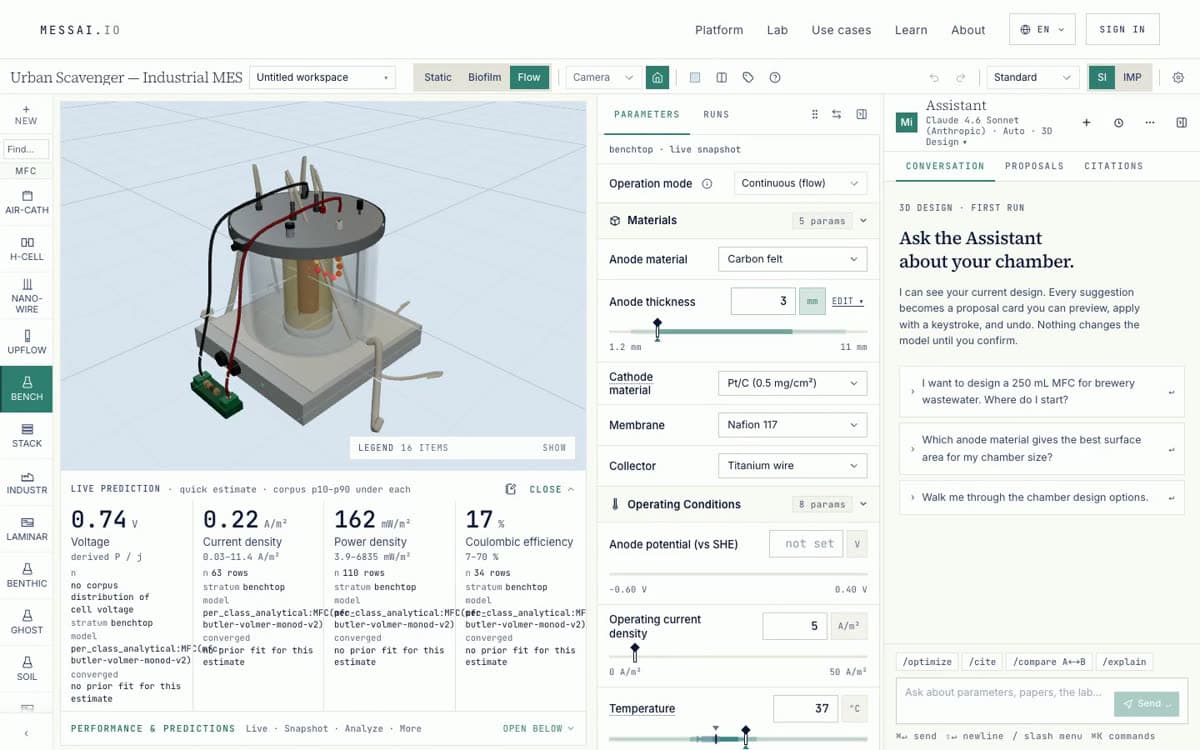
The scientists decide what is comparable; the product makes it askable
Whether two studies can be pooled is the group's scientific judgement, and a wrong call looks like a model result. So I put the questions in front of the scientists before fitting anything: hypotheses are rated testable or not, record definitions wait for their confirmation, and limits come first.
Open the pagemessai.io/collab
Key points
- Each of the 6 workstreams from the 8 October visit is a briefing with dated numbers, the questions we ask the group, and what is still open.
- Nitrogen cycling: 490 cohort papers, 34% with full text; a machine check found 96% of 308 sampled values in the paper. Nothing is called verified until a scientist has reviewed it.
- Signed-in readers comment on any element, so a correction lands beside the sentence it is about.
What needs scientific judgementWhich external studies are comparable, and which predictions would change an experiment?
Which missing prediction would change your next experiment?
A predictor is only worth fitting if its answer would change what a researcher does next. So in the Kolbe workstream the question is which parameter interactions would change the next experiment, not which outputs we happen to be able to predict. The same briefings ask which external studies can be pooled and what evidence a predictor needs first. The questions sit beside the data, and signed-in readers answer on the element they mean.
Awaiting researcher feedback. The group's row-by-row check of the Kolbe parameter sheet, and answers to the questions on each workstream briefing.
Current product decision. Modelling eligibility belongs to the paper, not to a row: a paper not classed as bioelectrochemical stays readable and comparable for researchers but out of the modelling pool. I made that call on 2026-11-03; the parameter-sheet rows themselves still await review by the group.
- Nitrogen cycling
490 cohort papers for a nitrogen-cycling question. Each machine-checked value sits beside its paper, so a scientist reviews evidence instead of collecting it.
- Kolbe electrolysis
The cohort behind decision 1. Kolbe electrolysis is abiotic, so its results are compared on their own page; a parameter-sheet review by the group is pending, and 11 PDFs wait behind it.
- Microbial electrosynthesis
The reactor geometries and operating windows the microbial electrosynthesis literature reports, set side by side so a new design starts from what has been run.
- Ontology and comparability
A shared vocabulary for system classes and parameters, so two papers are compared only when they mean the same thing. The catalogue is its test.
- Learning platform
Graduate-level lessons built from the corpus, each with its evidence linked, so a student meets the sources a researcher checks.
- Model setups and priors
Model setups, corpus meta-analysis and downloadable Bayesian priors, mapped to the thermodynamics and kinetics work, so a group can start a model from published evidence with its uncertainty stated.
Explore the six UFZ workstreams
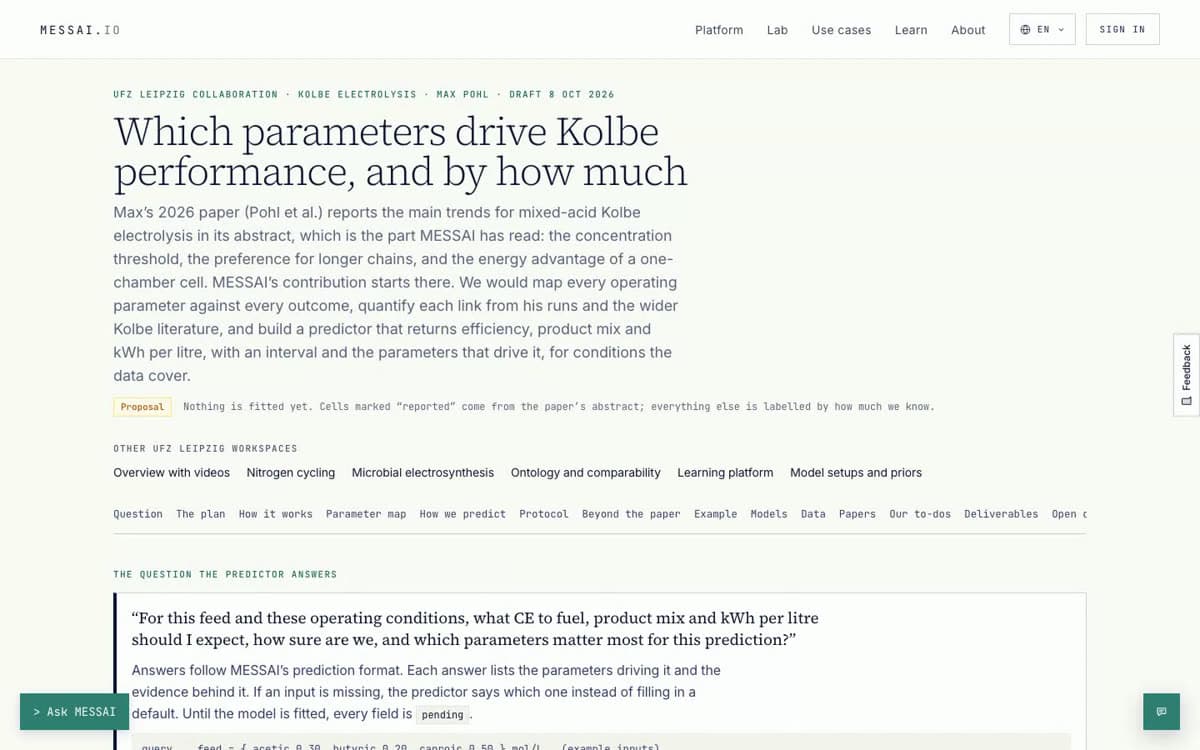
Useful to a researcher is not the same as eligible for a model
A UFZ group asked a question in abiotic electrochemistry, and extending extraction to answer it exposed an assumption: being in the corpus had quietly meant being eligible for a model. I made eligibility an explicit decision about the paper and held 2,838 off-corpus rows. On staging none had entered the served pool (production replay pending); the next cohort could have changed that.
Open the pagemessai.io/collab/pohl
Key points
- The Kolbe current densities stay comparable on the Kolbe page and never feed a bioelectrochemical prior.
- I fixed the rule, not the symptom: eligibility is decided where rows land and in the shared pool rule, kept equal in TypeScript and Python by a test. Hand-editing the 8 rows would have let the next abiotic cohort through.
- Nothing was deleted: a held row keeps its value, quote and page, and says why it is out. Deployment status: evaluated on staging on 2026-11-16; production replay pending as of that report.
Design principleRetrieval scope can be broader than modelling eligibility. Useful literature does not automatically become training or prior evidence.
- 01The researchers' problem
A UFZ group wants to know which parameters drive Kolbe electrolysis performance, and that literature is abiotic electrochemistry the platform had never read.
- 02The first decision
Give the cohort its own extraction specification rather than loosen the bioelectrochemical extractor, which by design returns nothing for an abiotic paper.
- 03The failure it exposed
The first run, on 2 of 11 PDFs, marked 8 abiotic values eligible for biological modelling: widening what we read had silently widened what we model.
- 04Fix the rule, not the rows
Eligibility became a property of the paper, checked where rows land and in the one shared pool rule. I rejected deleting the rows, which would have taken the values from the researchers who asked for them.
- 05The evidence
2,838 rows held back on 2026-11-16. On staging the served pool, 27,474 rows, was the same before and after: every held row had already been out through another rule. The production replay is pending, so this is not yet confirmed on production.
- 06What I took from it
What a researcher may read and what a model may learn from are separate decisions. Still open: the rest of the 11 cohort PDFs are pending review of the parameter sheet by the group.
Figure
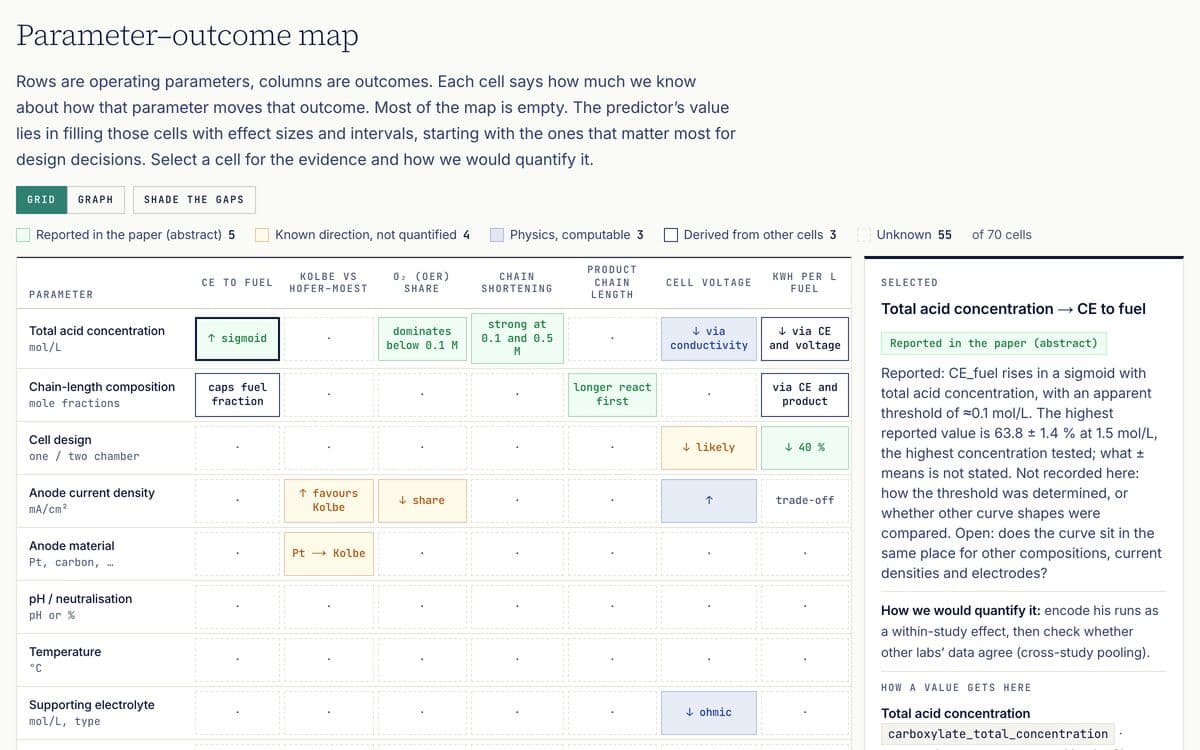
A filter is a claim about evidence, so show what it costs
A researcher deciding whether the modelling pool fits their question needs to know what it leaves out, not only how clean it is. So I publish the recall beside the precision, instead of the earlier precision headline on its own, where a partner scientist can see the trade-off and comment on it.
Open the pagemessai.io/collab/data
Open the evaluation card behind this claim
Key points
- On the same 20-paper machine-scored reference set, pending expert review (290 truth rows), live rows from primary papers score 95.8% precision and 88.3% recall; the modelling pool, the slice the priors read, scores 100% precision and 40.6% recall.
- The filters build a highly precise modelling subset that keeps less than half of the reference outcomes; recovering the evidence they discard is the next investment.
- Both numbers come from one evaluation and are never mixed with figures from another; they are point estimates on that set, not corpus-wide guarantees.
Trade-offThe filtered pool favours precision over completeness. The next question is which exclusions are necessary and which discard usable evidence.
Figure
Measured interval coverage, not demonstrated predictive improvement
No model cleared the benchmark gate, so a single accuracy figure would have hidden the most important result. The benchmark result is published as it came out.
Open the pagemessai.io/proof
Open the evaluation card behind this claim
Key points
- Because the benchmark gate was not met, I withdrew the predictive-accuracy claim; the product reports measured interval coverage, with the benchmark linked from the claim.
- Three evaluations make three separate claims: the benchmark gate, prior-interval coverage, and the published-anchor check with refusals counted apart. Coverage of the served point plus band is measured separately and is lower for some targets.
- An advertised "372 held-out predictions, ECE 1.96%" could not be reproduced from any stored evaluation, so I removed it from four pages; /proof now names the cohort and date of every coverage number.
Evaluation lessonAggregate coverage does not establish accurate point estimates or useful uncertainty for every setting.
Cross-paper predictive benchmark
No candidate passed the improvement gate.
bes-benchmark-v1: 3,593 rows from 590 papers, split by paper and leakage-audited. The gate asked for ten percent lower error than the class median with non-overlapping paper-bootstrap intervals; every model, closure and prior failed it, so no accuracy claim ships. The benchmark covers four targets.
Prior interval evaluation
Nominal 95% intervals covered 96.1% of 5,269 held-out values.
339 held-out papers; 122 values fell below their interval and 85 above. Coverage slightly above nominal suggests the aggregate intervals are a little wide; coverage alone establishes neither absence of bias nor point accuracy.
Published-anchor evaluation
The lab sweep and the live API scored differently; refusals are counted apart.
On 13 papers the lab sweep had 7 of 17 rows within 25% of the published value and 8 further than 50%; the API had 4 of 9 within 25%, refused 7 for want of inputs and returned no output once. 6 of the 9 reported values sat inside their stated interval. Only the headline rows were held out from tuning.
Figure
Working software: supporting evidence
Useful evidence for the three decisions; each page is live today.
An estimate that shows its evidence, or declines to give one
A modelling tool that always returns a number invites trust it has not earned. I chose to withhold rather than fill the gap, and wrote that behaviour down as a contract the code enforces: a withheld interval is null with method none. These are pipeline, evaluation and product decisions; no model training was involved.
Open the pagemessai.io/lab?model=benchtop
Key points
- Every live estimate shows its n, stratum and model under the number; sliders are bounded by what the corpus reports, across 17 system types in five physics families.
- On the bes-benchmark-v1 held-out rows (2026-09-02), the served physics predictor abstains on 96.7% of rows: a substantial limit on predictive coverage, not a success metric. When it abstains, the lab shows no number and names the missing inputs. The class median is the comparison bar in the benchmark, not an estimate the lab serves in its place.
- The chat assistant is instructed to ground numerical claims in tool results, state n on every median and avoid the word "typical" below five papers; how often it complies is not yet evaluated.
Design ruleWhen an estimate is withheld, explain what would make the question answerable.
Figure
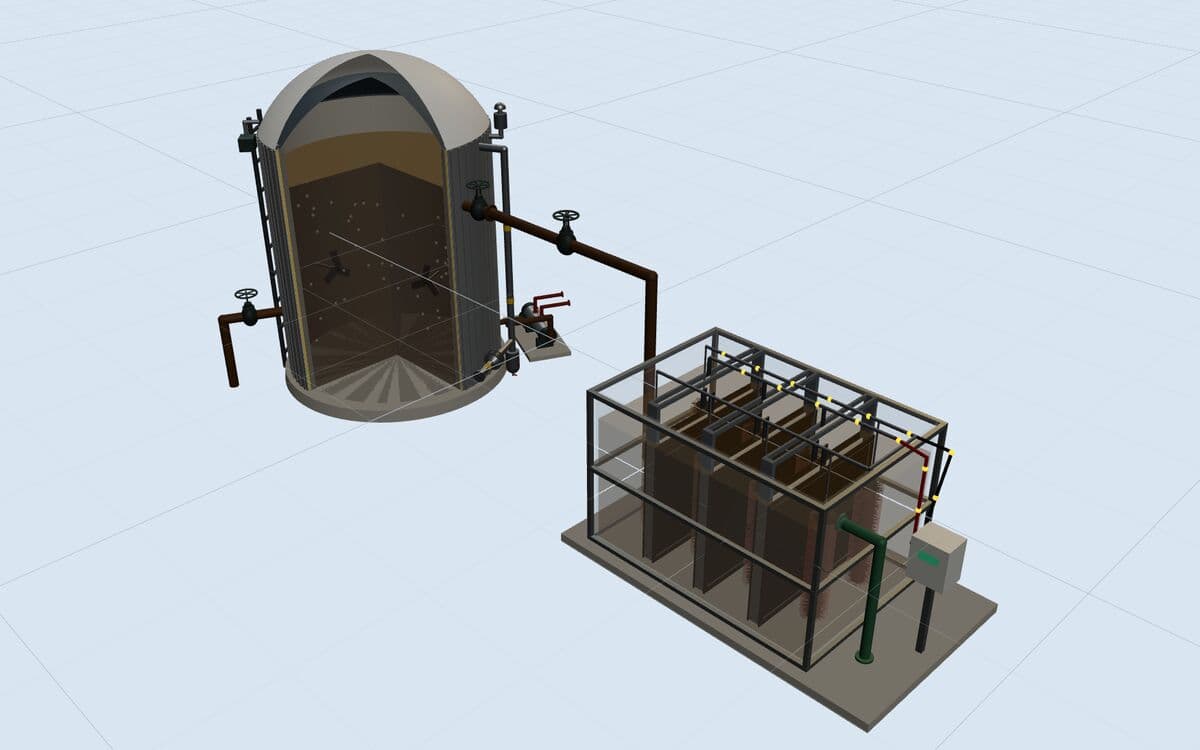
Separating unit errors from model errors
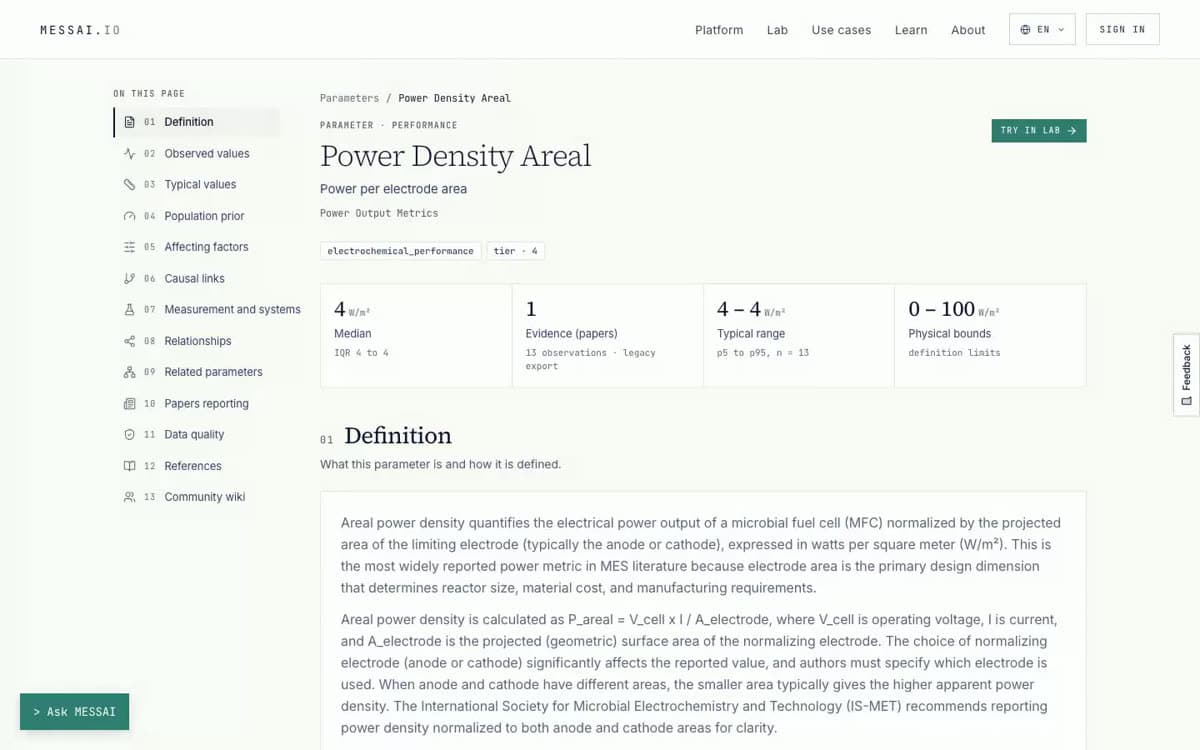
Papers report power per square metre of electrode and per cubic metre of reactor under the same name, and the two are not interchangeable. A team that tunes a model before it harmonises units spends its effort fixing the wrong thing.
Open the pagemessai.io/parameters
Key points
- The catalogue keeps areal and volumetric power density as separate parameters, among 835 definitions (production, 2026-10-25) with SI units, ranges and reporting papers.
- One shared unit library does every conversion; a second table would drift from the first and surface later as an apparent prediction error.
- Distributions are filtered to the physical range of the control that asks for them, so a junk row cannot become a slider bound.
Unit lessonComparability is a scientific decision, not just a unit conversion.
Figure
Hypothesised causal structure, with the gaps in the analysed corpus marked
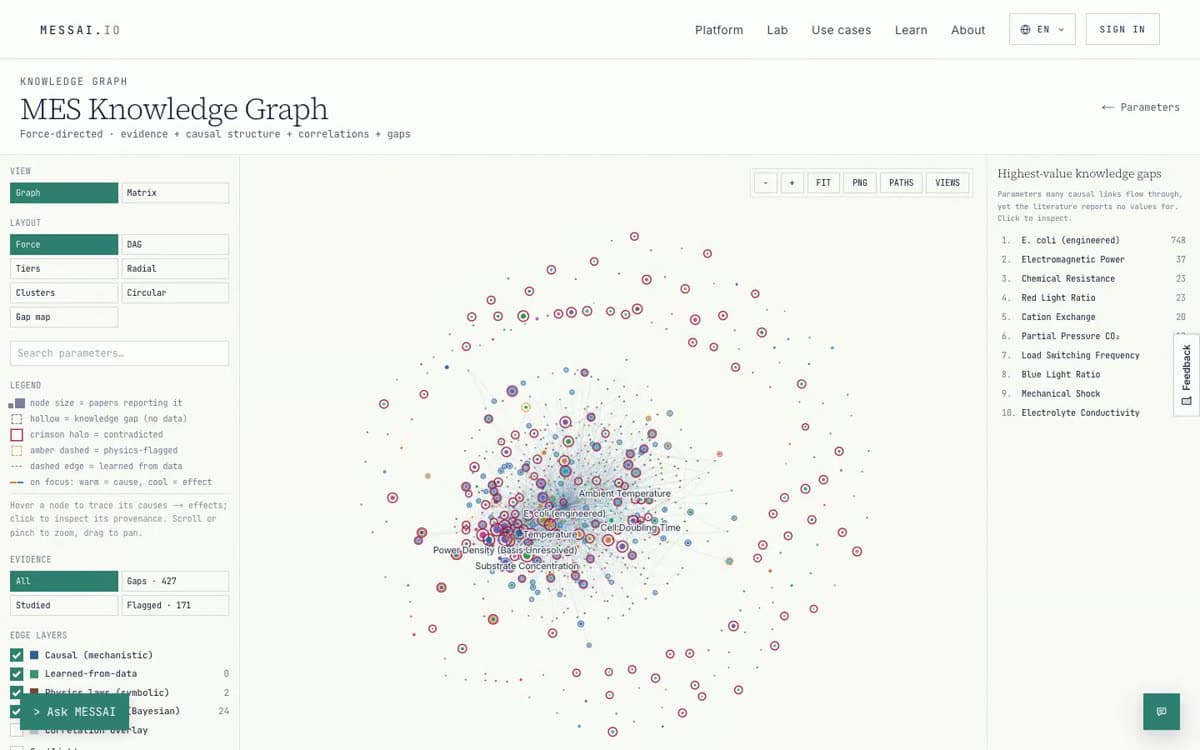
A researcher choosing the next experiment needs to see which parameters matter and which lack measurements in the analysed corpus. A gap map turns 'the literature is thin' into a list, and it is where a model's proposal of what to measure next could be checked against the evidence.
Open the pagemessai.io/parameters/knowledge-graph
Key points
- Mechanistic, learned and physics-law edges are separate layers, so a claim from domain consensus is not mistaken for one the corpus supports. Counts come from a dated snapshot and are labelled as such.
- Hollow nodes are parameters many causal links run through but which lack measurements in the analysed corpus; I draw the gap rather than hide it.
- Shareable views and path queries let a reviewer send the exact graph state they are asking about.
Using the gapsMissing evidence becomes useful when connected to a researcher's decision.
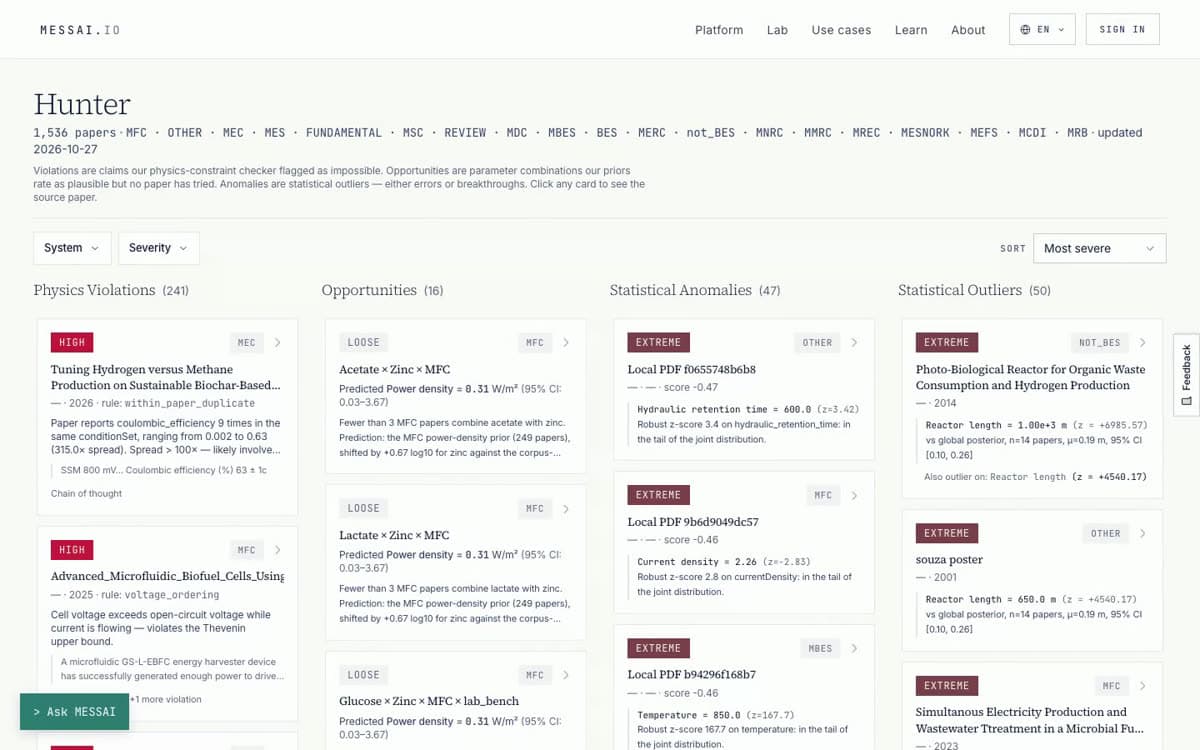
Plausible extraction errors, found by a domain check and fed back
LLM extraction looks right and is wrong in ways a domain check catches, so the evaluation had to come from the physics, not from fluency.
Open the pagemessai.io/hunter
Open the evaluation card behind this claim
Key points
- In a 20-paper, four-arm bake-off, 99 of 214 values that the previous extractor counted as measured in the paper were in fact cited from other studies.
- I replaced that extractor. The replacement produced none in the machine-scored 20-paper evaluation, and a critic pass checks each row for physical inconsistencies: unit slips of 10^4, P not equal to V times I, coulombic efficiency above 100%.
- Hunter lists each violation, anomaly and outlier beside its paper, so a reviewer goes from a suspicious number to its source in one click.
Check designA value appearing in a paper does not mean that paper measured it.
Figure
The corpus as a tool a model can call, with the source attached
I exposed the corpus through MCP so partner labs can test it within their existing AI workflows. Its usefulness on an end-to-end researcher task is not yet evaluated. Giving a model a tool is easy; what makes it useful to science is that the answer arrives with enough source to audit.
Open the pagemessai.io/developers
Key points
- A public read-only MCP server with 15 tools, two resources and three prompts, rate-limited with a hashed caller identity; admin tools are off the anonymous surface.
- Every API route checks who is calling before it answers, an automated check blocks an unguarded route from shipping, and diagnostic routes are closed on the public site; none of this has been independently security-reviewed.
- The public surface is read-only, so an agent cannot change the corpus researchers read.
Evaluation gapEvaluate whether an agent completes a scientific task, not just whether it calls a tool.
Figure
What I learned, and what I would build next
Three directions follow from what broke or stayed hard: comparability, missing evidence and expert review. Each names the user problem, the smallest next test and how success would be measured. I would start with evidence comparability: it addresses an immediate UFZ question and creates reviewed evidence sets that downstream modelling and evaluations both need.
How to read the numbers here
- Corpus counts move with every extraction run, so every figure here names the database and date it was measured on; a number without a date cannot be re-checked.
- "Verified" hides three different strengths of evidence, so I label them apart: a heuristic check at landing, a machine-scored evaluation, or review by a scientist. A scientific product that blurs them overclaims.
- 01
Make evidence comparability a first-class workflow
ProposedUser problem
Researchers cannot tell which measurements can legitimately be pooled. Rate denominators, electrode references, organism identity and operating conditions can each change what a comparison means, and a wrong call looks like a model result.
Smallest next test
Run one comparison from the UFZ workstreams, such as the Kolbe current densities, through a comparability check that shows for each measurement why it is pooled or excluded. No single similarity score, because it hides the reason.
Success measure
Fewer incompatible measurements included and a faster defensible comparison, judged by the researcher, with a second scientist auditing the pooled set.
- 02
Turn missing evidence into an actionable next step
ProposedUser problem
A withheld estimate protects the scientist from an unsupported number, but leaves them without a next step.
Smallest next test
For one UFZ question, link each withheld estimate to what blocks it: a missing input to enter, a literature search for comparable measurements, or an experiment-planning step.
Success measure
The researcher names the blocker correctly and takes the proposed step.
- 03
Capture expert review where it improves the system
ProposedUser problem
Researcher corrections are lost in email threads or arrive unstructured, so they fix one analysis and never reach the evaluations the product is developed against.
Smallest next test
Turn the element comments on one workstream into structured corrections (source attribution, units, comparability) and a versioned held-out evaluation set.
Success measure
Review effort per accepted example, agreement between reviewers, and a reduced failure mode in the next release.
The open work I would not skip (human review of the extraction reference set, the recall lost to filtering, and the production replay of the scope rule) is listed on /collab/data. Open the full list of open items
The platform map identifies implemented, partial and unimplemented features. Open the platform map
Technical notes
The scope rule for non-bioelectrochemical papers was evaluated on staging; its production replay is pending. Hunter and the knowledge graph read dated snapshots that are rebuilt by hand during a quality refresh, not the live database. Some parameter entries still show their canonical identifier while the readable display names are migrated.